
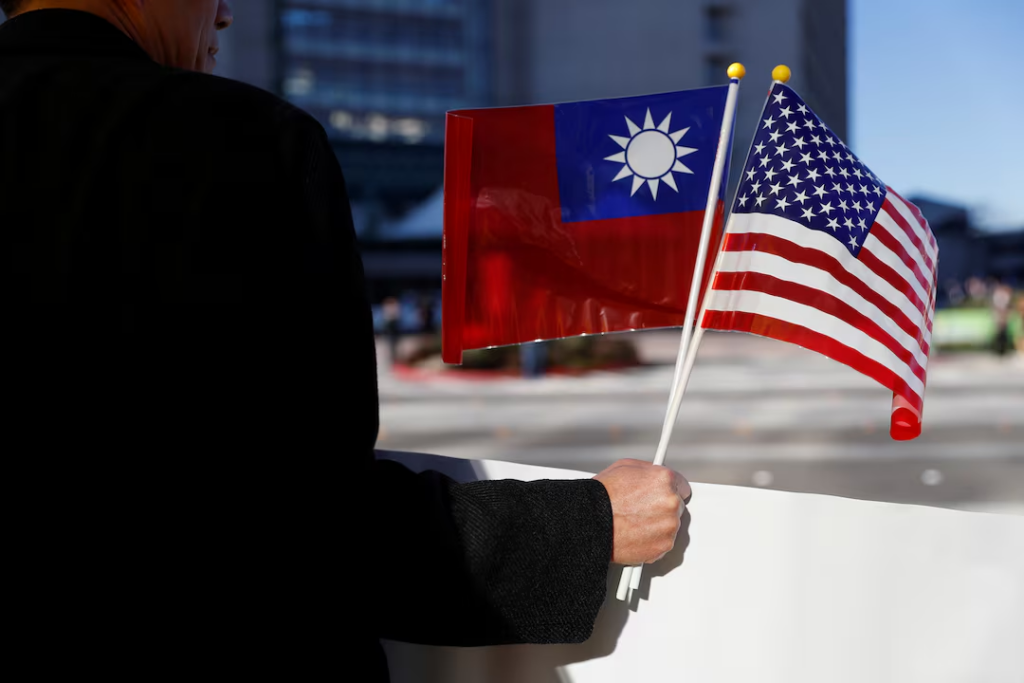
Photo from Reuters.com
In an era where innovation moves markets and national security depends as much on microchips as it does on missiles, the relationship between Taiwan and the United States stands as one of the most strategically vital partnerships in the world. For Taiwanese companies looking to expand globally, the U.S. isn’t just a good investment – it’s the launchpad for global relevance and resilience. Likewise, for the United States, doubling down on its support for Taiwan, particularly through legislation like H.R. 33 – the Taiwan Conflict Deterrence Act, is not just the right thing to do diplomatically, but an essential move to safeguard America’s own technological and strategic edge.
This isn’t just about economics. It’s about shaping the future – of supply chains, national security, and innovation leadership. Taiwanese firms like TSMC, Foxconn, and a growing wave of AI, biotech, and green energy innovators already understand the opportunity. The U.S., on its part, benefits not just from foreign direct investment (FDI), but from aligning with a partner that shares its democratic values and tech-first vision of the world. What the U.S. needs to do is make it easier – read: less bureaucratic – for that investment to scale. And despite political noise, FDI and national security alignment with Taiwan remain enduring pillars of U.S. policy.
The Strategic Importance of U.S.–Taiwan Business Ties
Taiwan and the U.S. share more than just business interests – they share a vision. Both are democracies, both are technological powerhouses, and both are facing rising security challenges in the Indo-Pacific. This makes their partnership not only economically sensible but geopolitically necessary.
At first glance, the U.S. “Buy America” and “Manufacture in America” policies might seem to discourage foreign investment. But these policies are focused on where goods are made—not who makes them. Taiwanese companies like TSMC and Foxconn are building factories in the U.S., creating thousands of American jobs, and producing products that qualify as “Made in America.” Their investments support these policies by strengthening domestic manufacturing and reducing reliance on less trusted nations.
What matters most is securing supply chains, boosting local production, and creating high-quality jobs – areas where Taiwanese firms excel. Business, in this case, becomes a shield. Every chip plant built on U.S. soil, every American dollar invested in Taiwan’s AI startups, adds a layer of mutual dependency that makes conflict harder and cooperation more valuable.
Taiwanese Companies and the U.S. Market: A Match Made for Global Expansion
For Taiwanese companies, the United States isn’t just another market – it’s the market. With a GDP topping $25 trillion and a consumer base that prizes innovation and quality, the U.S. offers an unparalleled opportunity for Taiwanese firms ready to scale.
Establishing operations in the U.S. sends a powerful message: you’re not just exporting – you’re integrating. For companies like TSMC, whose Arizona facility is a cornerstone of U.S. chip strategy, or Foxconn, still evolving its Midwest presence, this is about embedding into global supply chains, serving top-tier clients, and leveraging local government incentives aimed at reshoring production.
This isn’t limited to tech giants. Taiwanese SMEs in green energy, biotech, and EVs increasingly find that a U.S. footprint opens doors—from public grants to academic research partnerships. Investing in the U.S. also helps these businesses diversify away from regional risk, especially given rising tensions across the Taiwan Strait.
Access to Capital, Talent, and Innovation Hubs in the U.S.
The U.S. is not just the land of consumers—it’s the land of capital, talent, and ideas. For ambitious Taiwanese companies, that’s a winning combination.
Start with capital: the U.S. remains the global epicenter of venture funding and private equity. Taiwanese companies that establish a local presence gain access to investors eager to back trusted, innovation-driven partners.
Then there’s talent. The U.S. university system produces world-class engineers, researchers, and entrepreneurs. Firms that set up R&D hubs or regional HQs tap into this pipeline—and engage in co-development that drives both nations forward.
What makes it even more attractive are the U.S. innovation ecosystems throughout the U.S. where Taiwanese firms can plug into cutting-edge advancements and collaborations that can’t happen remotely.
FDI and Policy Support: A Welcoming Environment for Taiwanese Firms
You might wonder: will the U.S. really welcome more Taiwanese investment? The answer is yes—with nuance.
FDI from trusted partners like Taiwan is not only welcomed but strategically encouraged. While major initiatives like the CHIPS and Science Act and clean energy tax credits under the Biden administration aimed to boost domestic manufacturing have been stalled, defunded or lost in political friction, the opportunity remains. Taiwanese firms can step in to fill critical gaps and accelerate U.S. industrial revitalization. Even under more protectionist administrations, such as the current administration, foreign investment aligned with America’s domestic priorities remains valued, particularly when it creates jobs and localized strategic supply chains.
Taiwan fits that mold perfectly. Its companies don’t compete against American industry—they strengthen it.
How the U.S. Political Landscape Still Favors Foreign Investment
Political winds shift, but some interests stay constant. And when it comes to trusted FDI from Taiwan, bipartisan consensus in Washington remains strong.
Even during the Trump administration—known for its protectionist policies—alliances with Taiwan were prioritized. Why? Because Taiwan delivers what the U.S. needs: semiconductors, green energy components, and high-tech systems—all essential for America’s national and economic security.
As the U.S. shifts from dependency to resilience, Taiwanese investment is part of the solution—not the problem.
Why Taiwan Needs the U.S. as a Strategic Partner
This relationship is reciprocal. Taiwan doesn’t just contribute—it gains critical backing.
In a volatile region, Taiwan’s alliance with the U.S. is its most important line of defense. Not just militarily—but economically and diplomatically. Embedding operations into the U.S. economy makes Taiwan more resilient and allows Taiwan to diversify against aggression in the region.
National Security and Economic Policy: Why the U.S. Needs Taiwan
Here’s the flip side: the U.S. needs Taiwan just as much.
- Tech Superiority: Taiwan leads the world in chip production. Without TSMC, U.S. defense, auto, and electronics sectors falter.
- Trusted Partner: In a landscape of cyberthreats and supply chain risk, Taiwan is a democratic ally the U.S. can count on.
- Geopolitical Strategy: Taiwan is America’s counterweight to China in the Pacific. Every dollar invested solidifies that balance.
- Great Food: I thought I would mention this to see if anyone made it this far down into the article!
Taiwan is more than a supplier. It’s a linchpin in America’s industrial and security policy.
Looking Ahead: De-risking Through Deeper Integration
One word defines the future of investment: resilience. And resilience is built through diversification, trust, and shared values—all hallmarks of the U.S.–Taiwan alliance.
The world is moving away from risky dependence on singular markets. Taiwan’s expansion into the U.S., and America’s backing of Taiwan creates defense partnerships, and tech integration, resulting in a more secure, interdependent ecosystem that benefits both.
Conclusion
Taiwanese companies should view U.S. investment as not just smart business—but a long-term strategic play. The U.S., in turn, must continue treating Taiwan as not only a partner in democracy, but a cornerstone of its economic and national security agenda.
Together, they’re not just reacting to the changing world—they’re shaping the future of it.
About the AuthorGary Sumihiro is a global investment advisor and strategist. He is a board member of EDGE Partners and the founder of Sumihiro Investments. Mr. Sumihiro was previously appointed by the U.S. Secretary of Commerce to serve on the U.S. Investment Advisory Council and has spoken and judged at international investment forums. Mr. Sumihiro is also slated to judge and speak at the U.S. Department of Commerce’s SelectUSA Summit in Washington, D.C., in May 2026—an event bringing together global business leaders and government officials to shape the future of U.S. foreign investment strategy.
For EDGE inquires, please contact us at gsumihiro@edgepartners.us
