
When I was young, my family would take vacations along both the East and West Coasts, and I was always fascinated by the massive ships sitting in ports or moving slowly across the water. As a kid, I only thought about their scale — how something so enormous could float, how many containers they carried, and where they were headed. Years later, after entering the business world, I started looking at those same ships differently. Instead of just seeing steel and size, I started thinking about construction costs, financing structures, operating margins, utilization rates, and long-term return on capital.
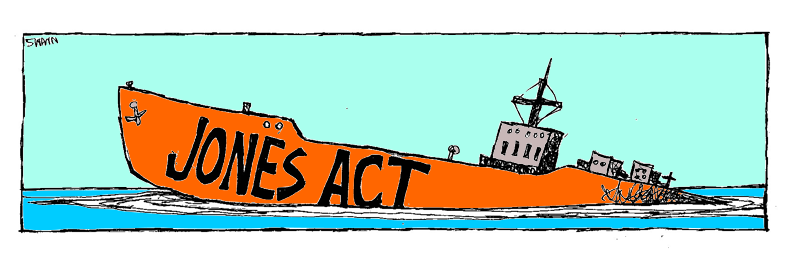
That’s why the recent suspension of parts of the Jones Act immediately stood out to me.
For over a century, the law required goods transported between U.S. ports to travel on ships that were American-built, American-owned, and American-crewed. That framework created a protected environment for domestic shipbuilding and gave investors confidence that expensive U.S.-built vessels would maintain long-term value. Whether people agreed with the law or not, it created something investors value deeply: predictability.
Now, even a temporary suspension introduces something markets dislike: uncertainty. The following are my current thoughts (I say current as in this political whirlwind, things could change tomorrow. My CURRENT thinking is the easing of protections could in the short term increase financial risk, slow capital investment, and pressure the value of existing U.S. shipbuilding projects.
The short-term reaction has understandably been negative. Large infrastructure and shipbuilding projects depend on policy stability, especially when billions of dollars are involved. If investors begin to believe these waivers could become recurring policy tools rather than rare exceptions, financing costs rise and long-term investment models become harder to justify.
But there may also be another side to this story.
Global shipbuilders like Hanwha Ocean, one of the largest and most sophisticated shipbuilders in the world, are likely paying very close attention. From their perspective, this may not simply look like deregulation — it may look like America signaling greater openness to international industrial partnerships. The United States needs more maritime capacity, offshore energy infrastructure, and modern shipbuilding capabilities, and rebuilding that ecosystem entirely alone would take enormous amounts of time and capital.For clarification, Hanwha Ocean doesn’t sail ships, they invested in the Philly shipyard that build the ships.
That doesn’t necessarily mean foreign firms replace American industry. In fact, the more realistic outcome may be collaboration. Allied international companies could bring capital, technical expertise, and production efficiency into U.S. maritime infrastructure while still supporting domestic jobs and strategic national interests. Advanced manufacturing technology from overseas could help America become even more competitive.
In many ways, the Jones Act debate has become bigger than shipping itself. It reflects a broader question about how America balances industrial protection, economic competitiveness, and global investment in a rapidly changing world economy.
And for investors watching closely, the real story may not just be about the risks created by this suspension — but about what a more globally connected American industrial future could eventually look like.
To be repetitive (and reinforce my point on a complicated subject), domestic shipbuilders, lenders, private equity groups, and infrastructure investors could model long-term investments knowing foreign competition was largely restricted. That legal protection became the foundation for billions of dollars in shipyard expansion, vessel financing, and maritime infrastructure investment.
Now, even a temporary suspension changes the equation.
The immediate concern for investors is not necessarily that the Jones Act disappears overnight. It’s that markets now have to consider the possibility that protections once viewed as untouchable may become negotiable during inflation spikes, geopolitical tensions, or energy disruptions. The attached analysis highlights how this uncertainty could increase borrowing costs, freeze capital expenditure, and pressure the long-term value of U.S.-built vessels.
And that matters because shipbuilding is not a short-duration business. These are multi-billion-dollar projects financed over decades. If lenders begin pricing in political uncertainty, financing becomes more expensive almost immediately.
In the short term, that’s clearly negative for parts of the domestic maritime industry.
But the more interesting question is what this means if the Jones Act gradually weakens over time — or if parts of it eventually disappear altogether.
For investors, the answer is probably more nuanced than either side of the debate wants to admit.
If the law were fully removed, traditional domestic shipbuilders would face enormous pressure competing against lower-cost foreign shipyards in South Korea, Japan, and China. Construction costs abroad can be dramatically lower, and that would likely compress margins across the U.S. maritime ecosystem. Existing U.S.-built vessels could also lose value if operators gain access to cheaper foreign alternatives.
At the same time, removing or loosening those restrictions could unlock a completely different wave of investment into the United States.
The U.S. wants stronger supply chains, expanded offshore energy infrastructure, modernized ports, and greater shipbuilding capacity. Rebuilding all of that domestically — and quickly — would require enormous amounts of capital, labor, and technical expertise. International firms could become part of that solution rather than simply competitors to it.
That’s where the investment story becomes more interesting.
If the Jones Act weakens, some capital will almost certainly leave traditional domestic shipbuilding models. But other forms of capital could enter. International infrastructure funds, sovereign wealth funds, maritime leasing companies, and foreign industrial groups may view the U.S. as a more accessible long-term market than they did before.
For companies like Hanwha, the opportunity may not be replacing American shipbuilding altogether. The more realistic path could be partnerships:
- Joint ventures with U.S. shipyards
- Offshore wind vessel collaboration
- Defense-adjacent manufacturing partnerships
- Port modernization investments
- Maritime leasing and financing platforms
That type of blended model may ultimately be where things are heading.
The broader reality is that America is trying to balance two competing goals at the same time:
- Protect strategic domestic industries
- Attract enough capital and industrial capacity to modernize them
That balance will not be easy, and the Jones Act debate sits right in the middle of it.
The future of the Jones Act may also end up telling us a lot more about the future of American investment.
About the AuthorGary Sumihiro is a global investment advisor and strategist. He is a board member of EDGE Partners and the founder of Sumihiro Investments. Mr. Sumihiro was previously appointed by the U.S. Secretary of Commerce to serve on the U.S. Investment Advisory Council and has spoken and judged at international investment forums. Mr. Sumihiro recently judged and spoke at the U.S. Department of Commerce’s SelectUSA Summit in Washington, D.C.—an event bringing together global business leaders and government officials to shape the future of U.S. foreign investment strategy. If you are serious about understanding how to enter the U.S. market, book some time through my Chief of Staff: mgeorges@edgeparters.us. Gary was also recently interviewed by Yomiuri in Japan about U.S. Investment; see the exclusive article here.