
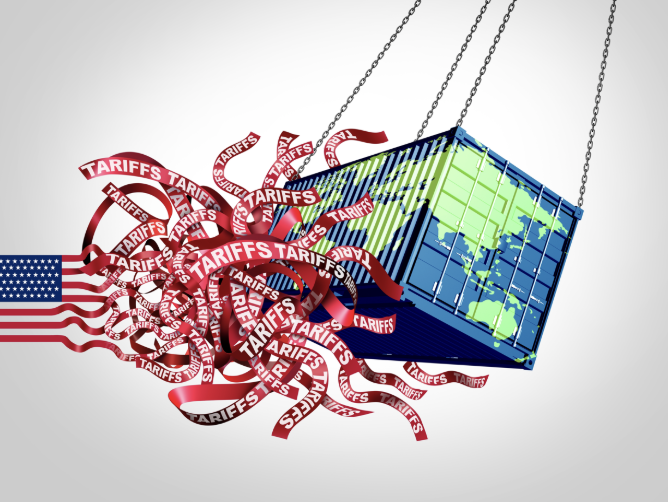
Photo from Alicia Garcia Herrero article
In June 1987, President Ronald Reagan gave a pivotal speech emphasizing the dangers of protectionism and advocating for free trade. His core messages were that:
– Tariffs hurt American consumers and workers.
– The U.S. should lead global efforts for open trade.
– Free markets promote innovation and competition.
A lot has changed since 1987. Instead of free trade and open markets, strategic protectionism and national interest are the buzz words of the moment. Today’s trade policies reflect pragmatic concerns around national security, economic competitiveness, and strategic resources. This shift is not only a result of the current administration’s policies, as the increase of tariffs on Chinese products, as well as securing critical minerals like copper, were also in effect in the prior administration. How to remain competitive globally, attract FDI, while promoting global expansion of U.S. businesses in this increasingly fractured global diplomatic arena presents major challenges for businesses.
The Trump administration’s latest trade policy shift – a 50% tariff on imported copper derivative products – is raising concerns through U.S. manufacturing, construction, and technology sectors. While framed as a national security measure, the tariff’s immediate effect is commercial: a sudden increase in import costs for copper-intensive businesses and a complex recalibration of global supply chains. But things change. Since the copper tariff announcement on July 30th, on August 4th, the administration had a reversal and confirmed iti that refined copper products—including cathodes, scrap, and concentrates—are exempt from the 50% tariff. The point is, companies need someone responsible for watching the evolving tariff rates.
Copper, long regarded as the “metal of electrification,” plays an indispensable role across industries. Electric grids, transformers, data centers, semiconductors, electric vehicles, and nearly every form of power transmission requires copper. From wiring to transformers, heat exchangers to renewable energy installations, the demand for copper is intensifying as the economy shifts toward digitization and decarbonization.
The new tariff – targeting semi-finished copper products such as rods, pipes, sheets, and electrical components – marks a sharp departure from previous administrations, which had largely exempted copper from sweeping trade actions. By invoking Section 232 of the Trade Expansion Act, the White House has asserted that overreliance on foreign copper inputs constitutes a strategic vulnerability.
Commercial Impact: From Cost Shocks to Contract Risk
For companies across construction, electronics, automotive, and telecommunications, the most immediate concern is cost. Businesses that rely on imported copper components may see material prices spike after duties are factored in. This will strain project budgets, trigger contract renegotiations, and could ultimately be passed down to consumers. While there are alternatives to copper for its conductivity such as gold, silver and experimental graphene, they are significantly more expensive while the most likely alternative, aluminum, has significantly less conductivity.
Smaller firms and new market entrants should be especially vigilant. Lacking established domestic supplier networks, they may struggle to absorb or offset the tariff’s impact. Additionally, long-term supplier agreements – negotiated before the tariff’s announcement – could expose companies to unexpected losses or breach-of-contract risks.
Further downstream, higher copper costs could ripple into data infrastructure, clean energy development, and national broadband expansion – all sectors where copper is essential. In the electric vehicle industry, for example, each EV requires up to four times more copper than a traditional car. The tariffs may compress margins or delay rollouts if supply chain strategies do not quickly adopt.
Strategic Options for U.S. Businesses
While the tariffs present challenges, there are actionable steps companies can take to mitigate their effects. Successful navigation will depend on a combination of sourcing agility, customs strategy, and proactive planning.
- Input Material Reclassification
The tariff applies only to semi-finished derivative products—not to raw materials such as copper ores, cathodes, or scrap. Importers can reassess product classifications and pivot toward sourcing unprocessed copper for domestic refinement or assembly, thereby avoiding the 50% duty. - Domestic Value Addition
Companies may benefit from “tariff engineering,” whereby imported raw inputs are transformed or assembled in the U.S. to create higher-value goods. This not only could potentially lower duties, but aligns with emerging domestic content incentives tied to energy and infrastructure funding. From a mid- to long-term perspective, the U.S. decision to impose high tariffs on copper clearly reinforces a not so hidden agenda to support the expansion of domestic manufacturing and downstream processing industries. - Customs Programs and FTZs
Importers should explore U.S. Customs programs such as bonded warehouses, Foreign Trade Zones (FTZs), and duty drawbacks to defer or recoup tariffs. These tools are underutilized but offer meaningful relief when structured correctly. - Supply Chain Diversification
The tariff provides a compelling reason to reassess sourcing geography. Establishing relationships with exempt countries or those negotiating bilateral agreement could provide future duty-free pathways, depending on how trade talks evolve. This is a predictive statement and not the current state. As of now, all countries have the same tariff rate but, given the “flexibility” in the administration to carve out country deals, this is something to constantly monitor. - Cost Containment in Entry Strategies
For new entrants, the key is to build tariff mitigation into the financial model from day one. This means modeling scenarios with and without duties, understanding Harmonized Tariff Schedule (HTS) classifications, and identifying domestic partners who can support finishing or assembly processes.
Conclusion: A New Era of Copper Trade Strategy
The copper tariff is not just a trade action – it is a signal. It suggests the U.S. is prepared to weaponize industrial policy in sectors it deems critical, even at the cost of short-term disruption. For commercial operators, this new reality demands strategic flexibility and rigorous cost management. For the short to midterm, some public/private grant availability should be considered to assist the development of local producers. For foreign companies entering the U.S. market for the first time, this should not be viewed as a “showstopper”, but one element that should be considered in the overall strategic entry equation.
Companies that treat this tariff as a one-time shock may find themselves exposed again as trade policy continues to evolve. But those that adapt – through supply chain redesign, domestic integration, and active policy monitoring – can position themselves to lead in a copper-constrained world.
About the author
Gary Sumihiro is the founder of Sumihiro Investments LLC, a global strategic advisor, and board member of several companies. Recently, Sumihiro Investments entered into a strategic relationship with EDGE Partners LLC. For more information about Sumihiro Investments and EDGE Partners see the linked article.