
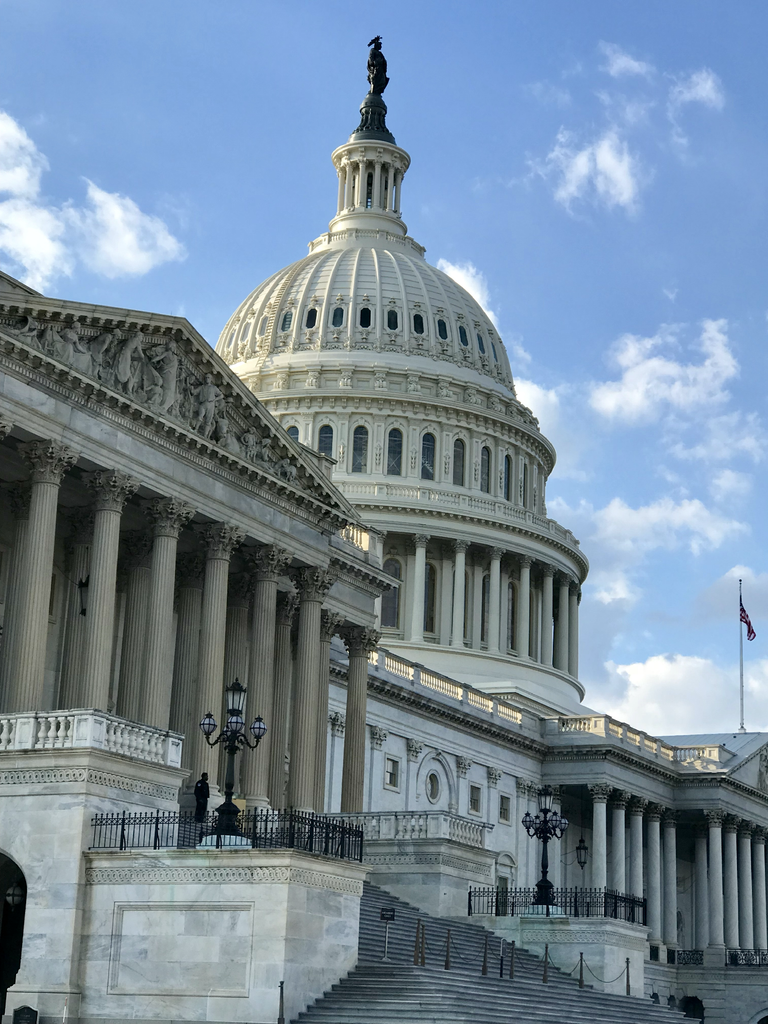
I took the picture. It was a quiet time on Capital Hill. A different time than now….
I am pretty sure I can say with confidence that we can assume that whoever loses will use every available political and procedural tool to slow, challenge or disrupt the winner’s agenda—especially if control is closely divided, and perhaps even after a clear result. In Washington, a decisive win can still buy two years of procedural trench warfare; compromise rarely gets the same attention. That is one cost of polarization, particularly when the loudest voices on either side have little incentive to make governing across differences look easy.
Saying that, the 2026 U.S. midterm elections may alter the political landscape in Washington and in state capitals. However, companies making international trade and investment decisions should avoid treating Election Day as a turning point that determines the future of the U.S. market. The results may affect the direction, pace and oversight of federal and state policy. They will not, by themselves, change the underlying commercial reasons that draw businesses to the United States—or end the country’s long-standing role in global trade and investment.
For businesses abroad, the practical question is not simply who wins. It is how the elections affect policy implementation, government priorities and the predictability of rules that guide long-term decisions. Trade agreements, tariffs, incentives and regulatory programs may receive renewed attention. Companies should prepare for that possibility while recognizing that the U.S. market remains open to international commerce and investment.
At the federal level, midterm elections determine control of the House of Representatives and part of the Senate. Those outcomes can affect legislation, federal spending, oversight and the prospects for new policy initiatives. Congress holds important constitutional responsibilities over foreign commerce and tariffs, while the executive branch administers trade policy and conducts many international negotiations under authority granted by Congress. That is how the separation of powers is supposed to work if we were in normal times. Nevertheless, a shift in congressional control can influence debate and oversight without automatically rewriting every existing rule (FN 1&2).
The midterm cycle also reaches well beyond Washington. In 2026, voters in 46 states will choose state legislators, and 36 states will hold gubernatorial elections (FN3). State governments shape many of the conditions that influence a company’s investment decision, including tax policy, economic-development incentives, workforce programs, energy and transportation infrastructure, land use and permitting. State-level races and ballot measures can therefore affect the practical cost, timing and feasibility of a project. The effects will vary by state, and not every state holds the same elections in the same year, but businesses should assess state-level policy alongside federal developments.
These distinctions matter for investors. A change in federal or state leadership may alter which issues receive attention, how programs are administered, or the prospects for legislation affecting particular industries. But many business decisions also depend on customer access, suppliers, workforce, financing, infrastructure, permitting and the stability of contracts and institutions.
The elections may influence the policy outlook for tariffs and trade agreements. Changes in congressional priorities can affect how trade measures are debated, funded, reviewed or translated into law. At the same time, the president and executive agencies have responsibilities under existing statutes that do not disappear when a new Congress convenes. The result is more likely to be a shift in emphasis, negotiation or oversight than an overnight reset of the entire U.S. trade relationship with the world.
For companies, this means tracking concrete developments rather than reacting to broad political signals. Relevant indicators include enacted laws, agency rules, formal trade actions, funding decisions, state legislation and the implementation schedules attached to them. Businesses with cross-border supply chains should map their exposure to specific products, countries and regulatory requirements. Investors considering a U.S. project should examine the rules and commitments that apply to their sector and location, and build reasonable flexibility into plans where policy uncertainty could affect cost or timing.
Waiting indefinitely for political uncertainty to disappear can carry its own commercial risk. While a company remains on the sidelines, a competitor may move first to secure a strategic customer, negotiate a favorable long-term supply or offtake agreement, reserve logistics capacity, or establish relationships with local suppliers and distributors. In markets where port, rail, warehouse, energy or other infrastructure capacity is limited, early commitments can shape the options available to later entrants. These advantages are not guaranteed, and they do not replace careful due diligence. But a delayed decision can leave a company with higher costs, fewer partners or less favorable terms than those available to an earlier mover.
The scale of the U.S. market helps explain why global businesses continue to pay attention through election cycles. The United States is deeply connected to international commerce. In 2025, related-party trade—trade between affiliated companies—accounted for 42.8 percent of U.S. goods trade, worth nearly $2.4 trillion. That is a measure of how much cross-border commerce is woven into the operations of multinational businesses, rather than conducted at arm’s length between unrelated buyers and sellers (FN4).
Foreign direct investment offers another perspective. Preliminary Bureau of Economic Analysis data show that foreign investors spent $232.2 billion in 2025 to acquire, establish or expand U.S. businesses, a 49.5 percent increase from 2024. The largest portion—$218.4 billion—went to acquisitions of existing businesses; $4.6 billion went to establishing new U.S. businesses, and $9.2 billion to expanding existing foreign-owned businesses. The headline total does not mean all of the money built new facilities. Still, it shows substantial ongoing international capital flows into U.S. companies and operations (FN5).
The accumulated investment base is also significant. The foreign direct investment position in the United States reached $5.86 trillion at the end of 2025, according to BEA data. That total reflects years of investment and long-term commercial relationships. It is not a forecast of future investment, but it helps put short-term political cycles in context: companies have built and acquired U.S. operations over time, and those operations are connected to global production, services and finance (FN6).
This continuity does not mean that every sector faces the same outlook. Trade-exposed manufacturers, technology companies, energy businesses, infrastructure developers and firms in regulated industries may face distinct questions about tariffs, public funding, export controls, permitting or supply-chain rules. A project’s prospects can also vary substantially by state and locality. State and local governments play an important role in site development, workforce programs, infrastructure, taxes and permitting, and those factors remain part of the investment decision regardless of the national election calendar.
Foreign investors should distinguish the United States’ general openness to investment from its national-security review process. The Treasury Department describes U.S. policy as open to foreign investment, while CFIUS reviews certain transactions for national-security concerns. That review is an important consideration for some investors, especially in sensitive sectors or transactions involving access to critical technology, infrastructure, data or land. It is not a blanket prohibition on foreign investment. Early assessment of whether a transaction may require review can help companies plan their structure and timing (FN7&8).
The 2028 national elections will bring another period of debate over economic priorities. Businesses should expect policy discussion to continue as candidates outline different approaches to trade, taxation, industrial capacity and international engagement. But political competition is not, by itself, a reason to put every U.S. investment on hold. Long-term projects often cross multiple administrations and Congresses. Their success depends on sound market analysis, realistic financial assumptions, careful compliance and the ability to adapt to policy changes.
A useful approach is to plan for continuity while monitoring change—and to weigh the cost of delay alongside the risk of acting. Companies can identify which federal or state policy decisions would materially affect their business, assign responsibility for tracking them, and develop alternative scenarios for costs, sourcing or project timing. In parallel, they can assess which customers, suppliers, sites or logistics arrangements may become harder to secure over time. That allows leadership to distinguish between decisions that should wait for more information and commercial opportunities where early engagement is valuable.
The United States is not insulated from political change, and no responsible investor should assume that every policy will remain constant. Elections can influence debate, the pace of legislation and government priorities at both the federal and state levels. Yet the U.S. economy is supported by a broad commercial base: a large consumer market, established financial and legal systems, research institutions, skilled workers, extensive infrastructure and businesses linked to customers and suppliers around the world. Those fundamentals do not change on election night.
No matter who wins the 2026 midterms—or who wins the national elections in 2028—the United States remains open for business. The policy environment will evolve, as it does in every major market. For international companies, the sound response is to understand the rules, assess sector-specific risks and make decisions on the basis of long-term commercial opportunity. Elections matter. So do the durable economic relationships, institutions and market opportunities that continue to connect the United States with the world.
About the author
Gary Sumihiro is the founder of Sumihiro Investments LLC, a global strategic advisor, and board member of several companies. Recently, Mr. Sumihiro joined the board of EDGE Partners, a global transactional firm.
Footnotes
[FN1]: Congressional Research Service, Congressional and Executive Authority Over Foreign Trade Agreements.
[FN2]: Office of the U.S. Trade Representative, Trade Promotion Authority.
[FN3]: National Conference of State Legislatures, NCSL State Elections 2026 and 2026 Elections Put Statehouses, Ballot Measures in the Spotlight.
[FN4]: U.S. Census Bureau, International Trade data and reports.
[FN5]: U.S. Bureau of Economic Analysis, New Foreign Direct Investment in the United States, 2025 (June 10, 2026).=
[FN6]: U.S. Bureau of Economic Analysis, Direct Investment by Country and Industry, 2025 (July 21, 2026).
[FN7]: U.S. Department of the Treasury, Is the United States Still Open to Foreign Investment?
[FN8]: U.S. Department of the Treasury, Can Foreign Investors Still Invest in the United States’ Technology Industry?